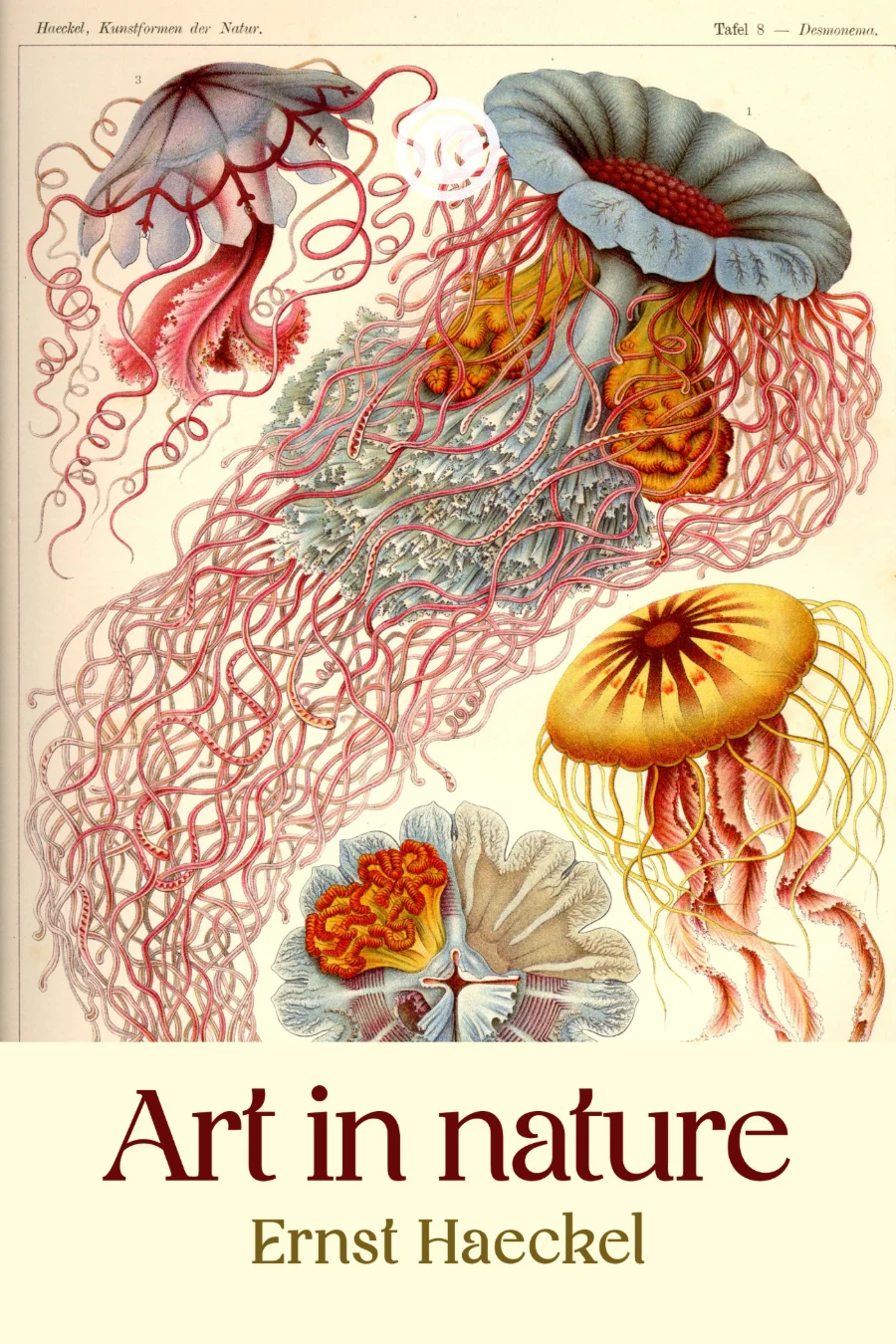
Art Forms in Nature
Fifty lithographic plates from Ernst Haeckel's Kunstformen der Natur (Art Forms in Nature), published between 1899 and 1904 — one of the most beautiful scientific works ever produced. Haeckel, a German biologist who coined the terms "ecology" and "phylum," believed that the natural world's deepest structures were also its most beautiful. These plates prove him right: jellyfish trail gossamer tentacles in perfect radial symmetry; sea anemones bloom like underwater flowers; diatoms arrange themselves in geometric patterns that resemble Art Nouveau ornament — because Art Nouveau ornament was inspired by them. Émile Gallé designed his glass after Haeckel's radiolarians; René Binet modeled the gateway to the 1900 Paris Exhibition on Haeckel's drawings. The plates bridge the gap between science and art more completely than any other work: each organism is rendered with scientific precision and artistic sensibility, its beauty inseparable from its biological truth.