Thirty-six Views of Mount Fuji
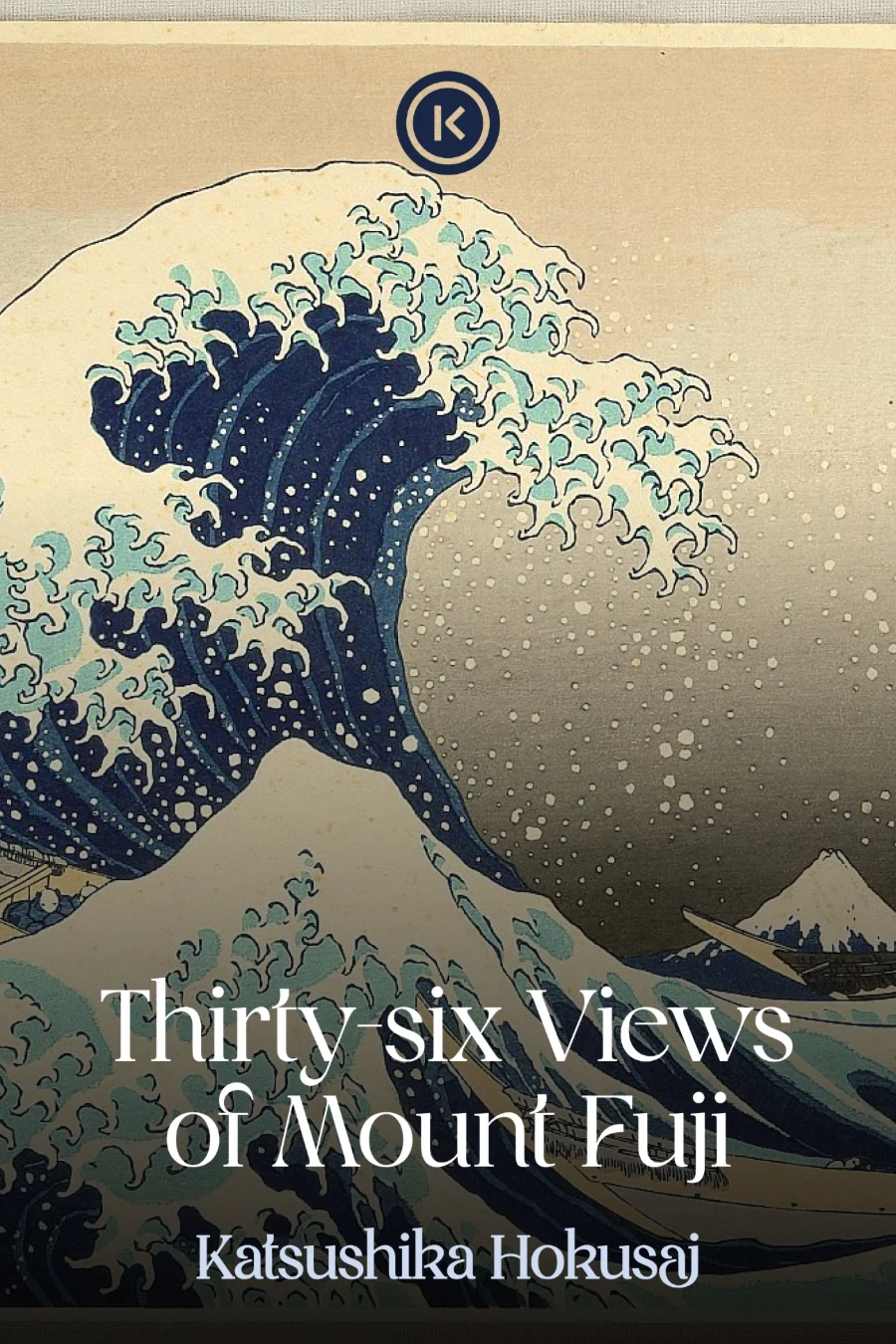
In the shadow of Japan's most iconic mountain, everyday life unfolds with quiet magnificence. Fishermen haul their nets beneath Fuji's snow-capped peak, travelers pause on bridges to glimpse its distant form, craftsmen labor in workshops with the mountain rising beyond their windows. This is not a single narrative but a visual meditation—a series of woodblock prints that transforms one sacred mountain into thirty-six different encounters, each revealing how landscape and human activity interweave in early nineteenth-century Japan.
Hokusai's vision moves between the monumental and the intimate with startling fluidity. The mountain appears sometimes as a dominant presence filling the composition, sometimes as a mere triangle on the horizon, nearly overlooked amid crashing waves or swirling winds. What emerges is less a documentary record than a philosophical exploration of perspective itself—how the same unchanging form can be endlessly new depending on where we stand, what season we witness it in, what labor or leisure occupies the foreground. The technical precision of the woodblock printing technique, with its bold lines and revolutionary use of Prussian blue, creates images that feel both grounded in specific moments and somehow eternal.
The work speaks to anyone drawn to the tension between constancy and change, between the natural world and human presence within it. Hokusai invites contemplation rather than passive viewing, asking us to notice how frame and vantage point shape reality. These prints reward the patient observer, the traveler who understands that arriving somewhere once is never enough, that true seeing requires returning again and again from different angles. For readers who find meaning in attention itself, who believe landscape is never merely backdrop but active participant in human experience, this collection offers a profound and endlessly renewable encounter.