An Unpleasant Predicament
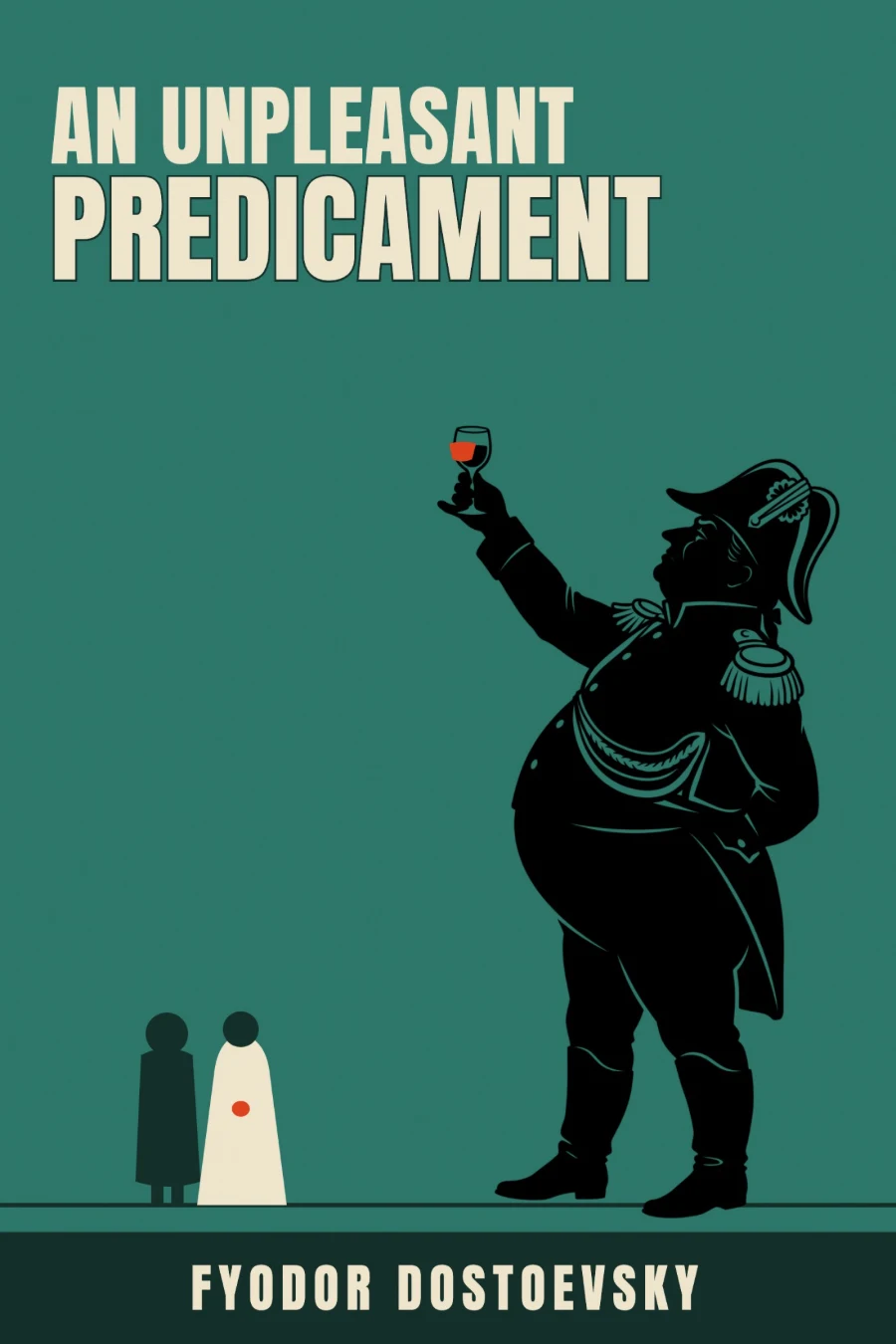
On a freezing night in Petersburg, three generals dine and talk reform — humanity, progress, the new relations that ought to obtain between superior and subordinate in the post-emancipation empire. One of them, Ivan Ilyich Pralinsky, decides on his walk home that he will prove his progressive principles in action. He turns into the cheap district where one of his most junior clerks, Pseldonimov, is celebrating his wedding, and presents himself uninvited at the door. The clerk, terrified, ushers him to the place of honour. The wedding party, half-drunk and half-asleep, tries to accommodate the impossible guest. Everything that follows is the slow, agonising consequence of a generous gesture from someone with too much power to be received as a guest.
Dostoevsky published An Unpleasant Predicament in 1862 in his journal Time, in the brief liberal moment between the emancipation of the serfs and the political crackdown that followed. It is one of his sharpest social satires and one of the very few of his major works set entirely in one night and one room. The slow accumulation of small humiliations — Pralinsky's failed attempts to make conversation, the cabbage-soup, the cologne, the wedding bedstead, the eventual collapse — is rendered with a comic precision that anticipates Chekhov's later treatment of the same material thirty years later.
An Unpleasant Predicament rewards readers who want Dostoevsky as social anatomist rather than metaphysician — the writer who understood, before nearly anyone, that liberal good intentions exercised at scale produce humiliations as exact as any tyranny. It rewards them with one of his funniest and most painful set-pieces, and with a closing image — Pralinsky returning home in the small hours, ill, ashamed, formulating his new theory — that has been replayed across a hundred subsequent novels of the well-meaning man who has just made things worse.