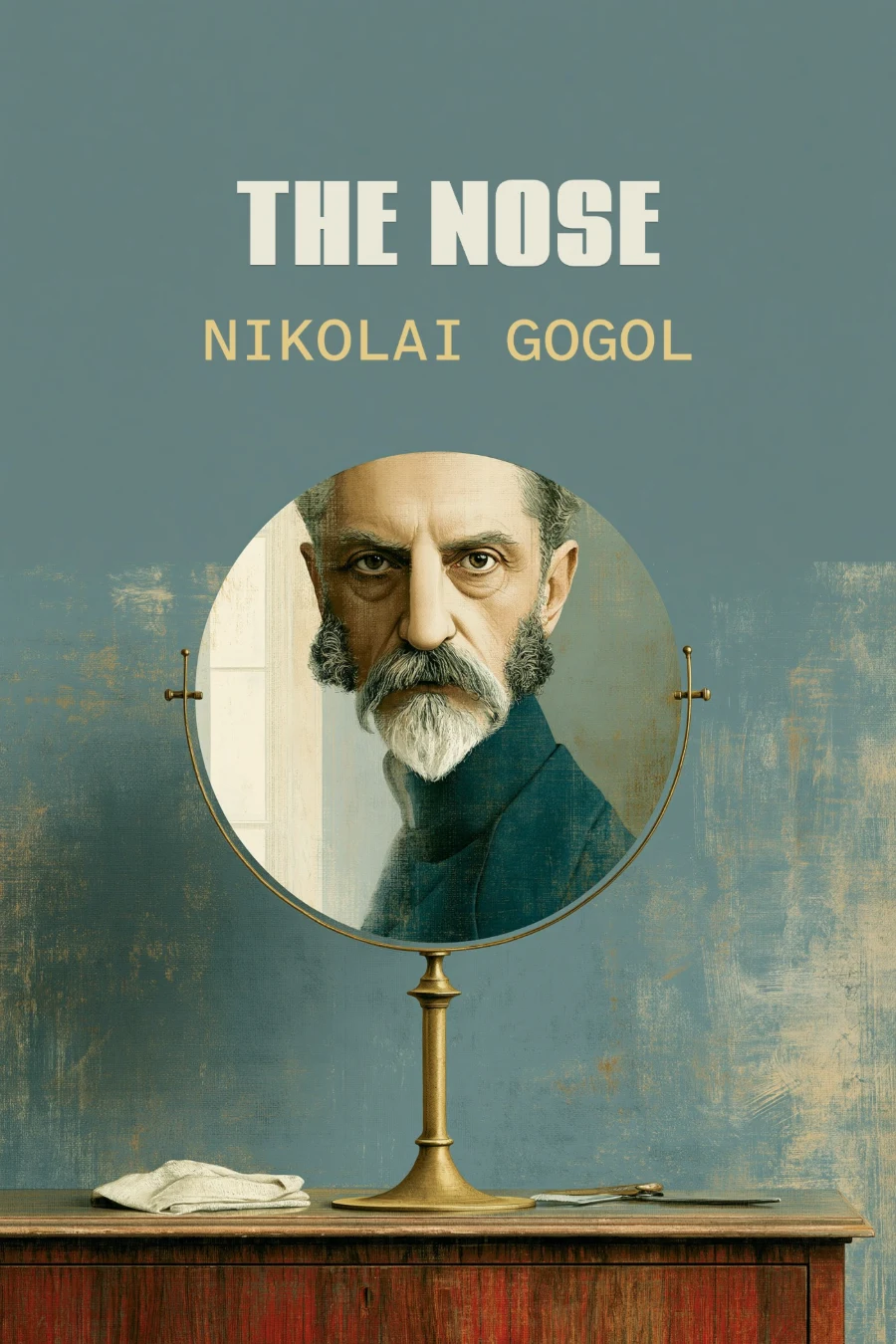
The Nose
On the 25th of March, a Petersburg barber finds his employer's nose baked into a loaf of his wife's morning bread. Across the city, in another apartment, Collegiate Assessor Kovalyov wakes, looks in the mirror, and discovers a flat space where his nose used to be. Setting out in increasing panic to file a missing-persons report, he finds his own nose stepping out of a carriage on the Nevsky Prospect — dressed in the uniform of a State Councillor, several ranks above Kovalyov, and treating its former owner with cool aristocratic condescension. The story that follows is the report of Kovalyov's attempts to recover his face through every channel the imperial bureaucracy provides: a newspaper advertisement, a police inquiry, a private supplication to the nose itself.
Gogol published The Nose in Pushkin's journal in 1836, and the story has been read ever since as the founding document of literary absurdism. Kafka, Bulgakov, Borges, and Beckett all worked in territory it opened. It is also a precise satire of Petersburg's table-of-ranks society, in which a uniform conferred more dignity than a face. The bureaucratic obstacles Kovalyov encounters — the editor who refuses to print the advertisement on grounds of credibility, the police clerk who treats the missing nose as a misdemeanor of property — are perfect in their petty realism. Gogol refuses, scrupulously, to provide any explanation for the disappearance. The narrator at one point breaks off to admit he himself cannot understand how such things happen.
The Nose rewards readers who appreciate the absurd held to absolute realist discipline — the nose's uniform is described in the same prose as the bread roll — and who recognize, in Kovalyov's social humiliations, the universal comedy of a man whose status has detached itself from his person. It is the indispensable Russian short story for understanding everything that came after, and the funniest argument ever made that human beings are largely walking ranks.