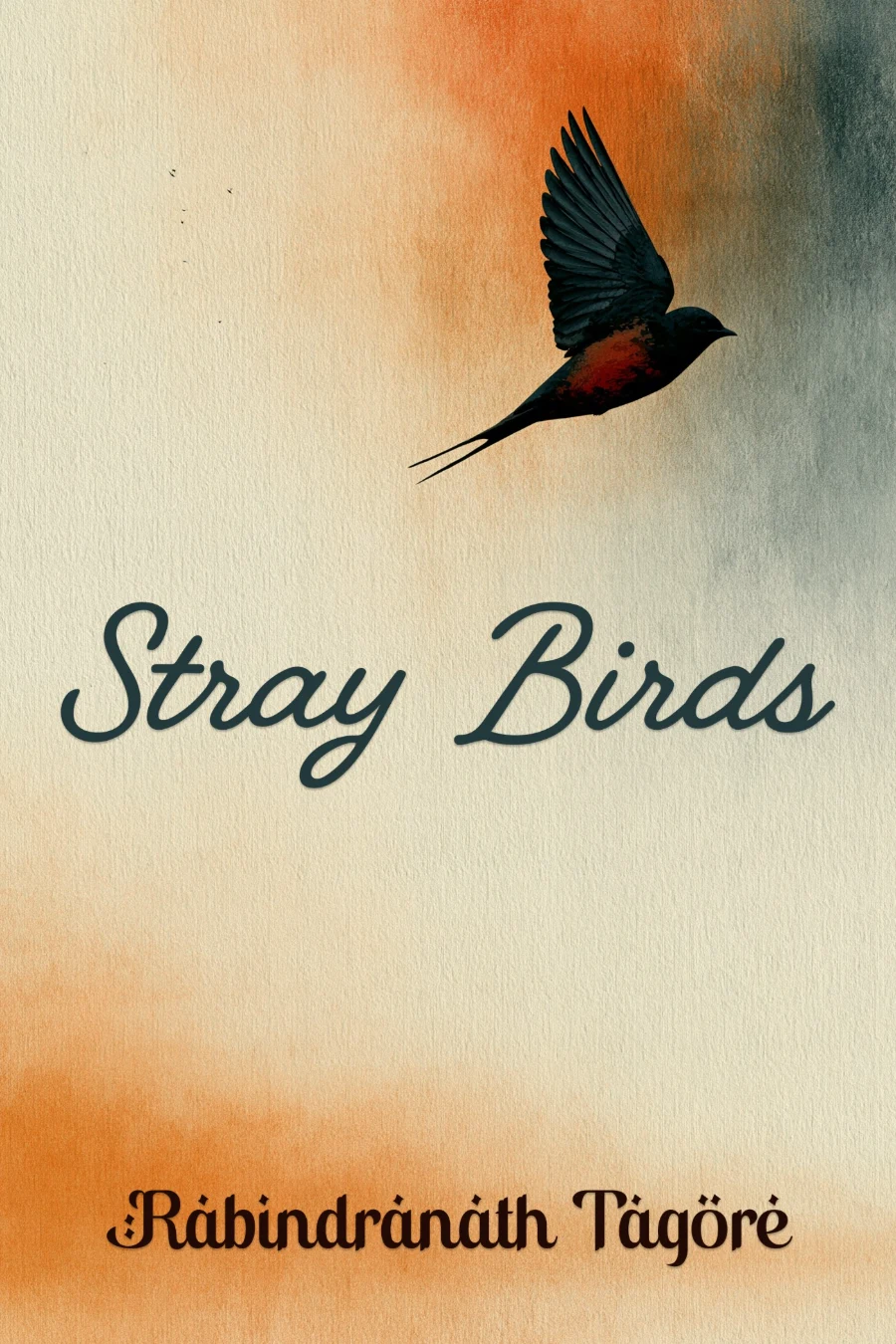
Stray Birds
Three hundred and twenty-six aphorisms, each short enough to be read in a single breath. Stray Birds was published by Macmillan in 1916, in the same wave of post-Nobel attention that had brought Gitanjali, The Crescent Moon, and The Gardener to English-speaking readers a few years earlier. Many of the fragments were written during Tagore's lecture tour to Japan and the United States that year; he translated them himself from the Bengali, and dedicated the English edition to T. Hara of Yokohama, his host during the Japan leg of the trip.
The form is old — the Sanskrit subhasita, the Persian masnavi, the Chinese epigram — but the sensibility is unmistakably Tagore's. A bird in the autumn sky. A leaf falling on a song. The world putting off its mask of vastness to its lover. Many of the entries circle the relation between the soul and the universe; many describe the way a moment of attention can give back an image of the whole. None argue; they offer.
The book has had the strange afterlife of all aphorism collections — quoted out of context, set to music, passed from hand to hand for over a century. Read all the way through in one sitting, it recovers what the snippets lose: the slow accumulation of a single mind discovering, three hundred and twenty-six times, that the universe is willing to be addressed.