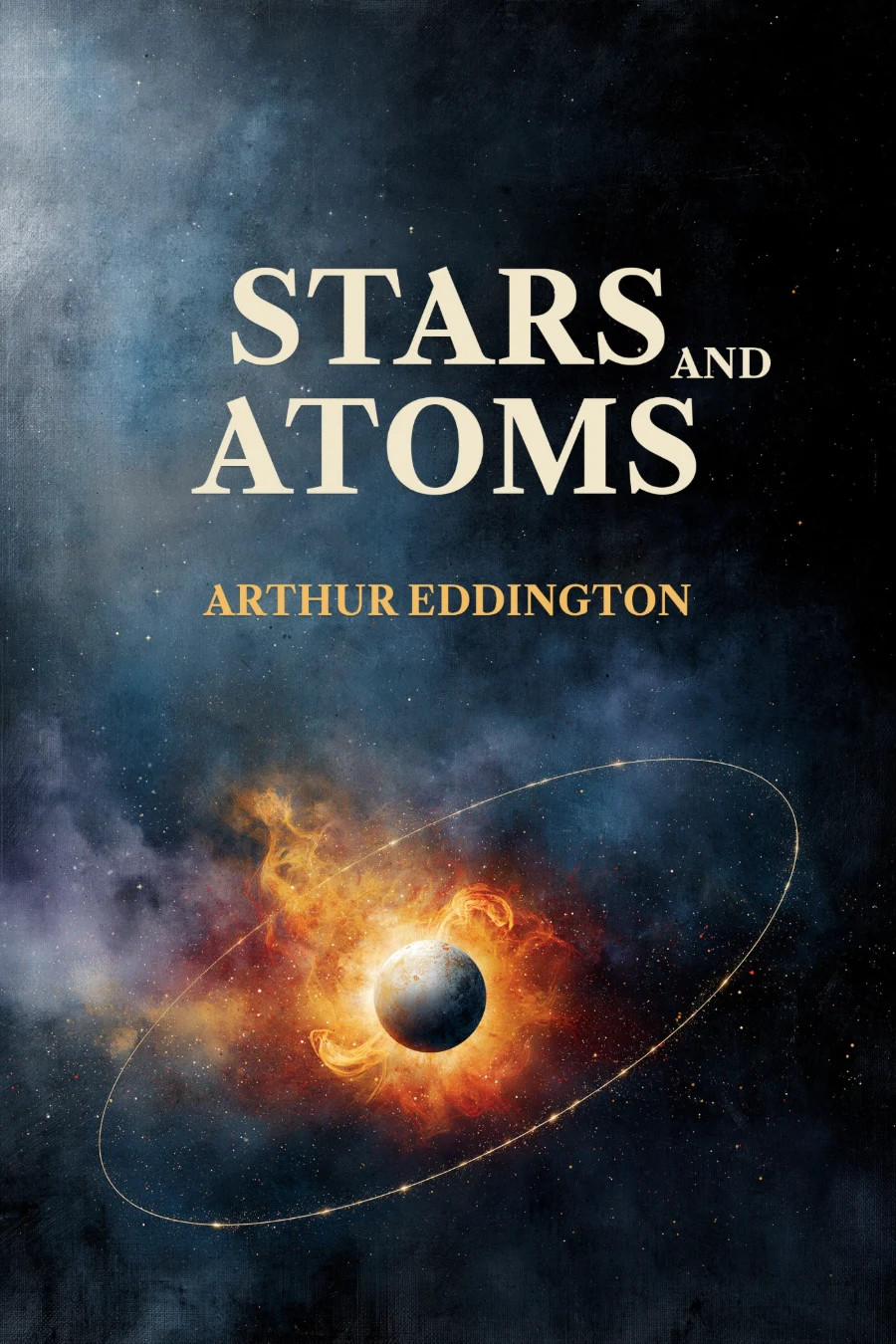
Stars and Atoms
3h 8m
37,482 words
en
Thirty cricket balls roaming the hollow interior of the earth mirror the density of stars in the heavens. A single drop of water holds billions of atoms, each acting as a miniature planetary system where electrons pursue their orbits. Situated midway between these extremes of scale is the human body—an organism requiring octillions of atoms for its construction, just as octillions of bodies would provide enough material to assemble a single star.
Derived from a series of public addresses, the text maps the physical mechanics of the cosmos. The lectures examine the interior architecture of a star, calculate stellar age and the radiation of mass, and outline recent investigations into the Companion of Sirius and the spiral nebulae positioned outside our own stellar system.
Published as classical physics gave way to quantum theory and relativity, the book documents early twentieth-century science in a state of rapid upheaval. It established an early standard for public science communication, translating the mathematics of astrophysics and atomic theory into a concrete scale of reality.