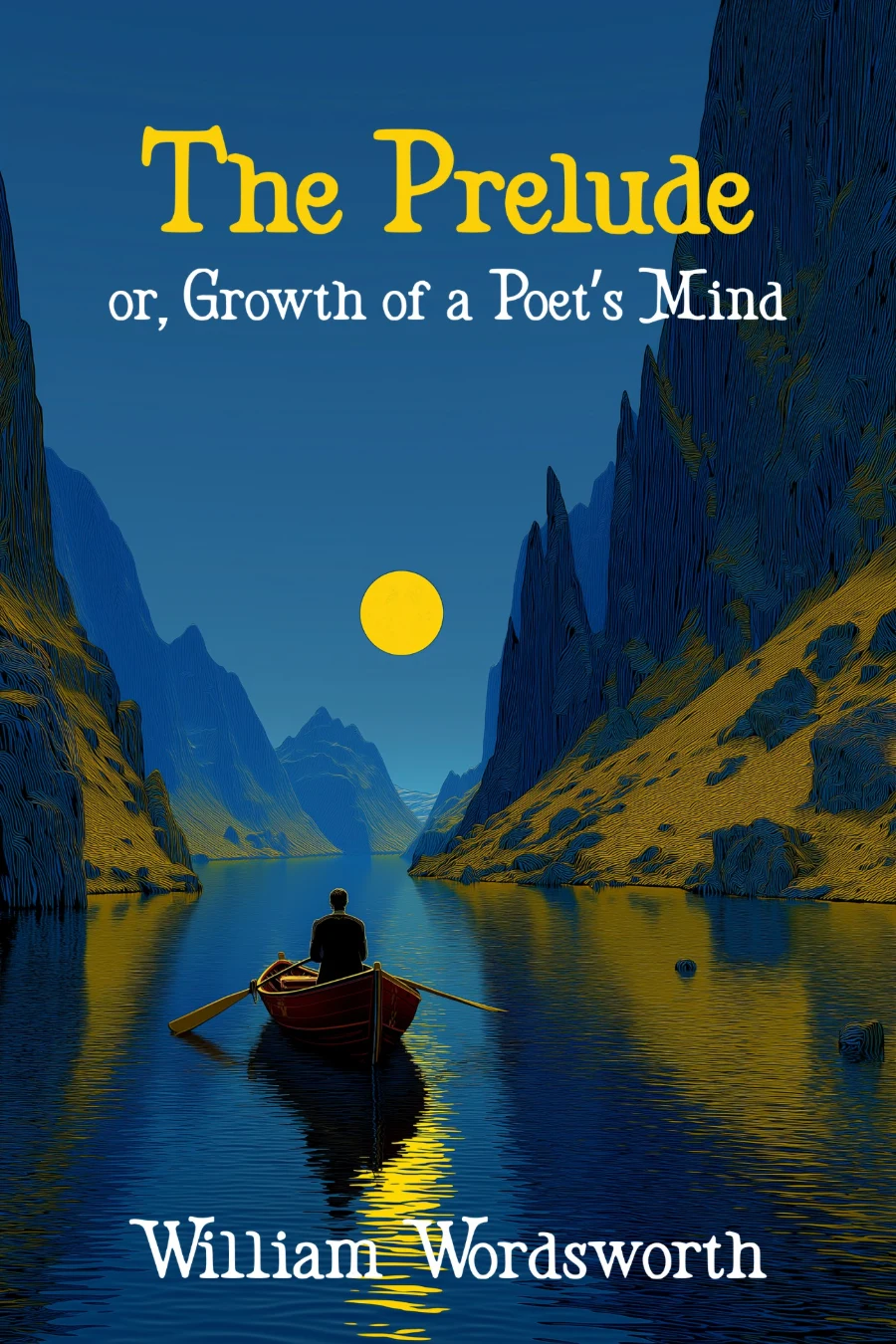
The Prelude; or, Growth of a Poet’s Mind

The Prelude; or, Growth of a Poet’s Mind

William Wordsworth

4h 52m
58,330 words
en

Tracing the growth of the poet’s mind from childhood in the Lake District through Cambridge, London, and revolutionary France, it explores how nature, memory, and imagination shape human consciousness. One of the greatest long poems in English, it gave us “The Child is father of the Man” and affirmed that “what we have loved, / Others will love, and we will teach them how.”
What shapes a poet's consciousness? What transforms a country boy who climbs mountains and skates on frozen lakes into an artist capable of perceiving the invisible forces that move through nature and human society? This vast autobiographical poem in blank verse traces the formation of a creative mind from childhood through young adulthood, mapping the inner geography of memory, sensation, and revelation that precedes the making of art itself.

Wordsworth moves through the landscapes of his youth—the English Lake District, Cambridge University, revolutionary France—but his true subject is the more elusive territory of perception and growth. He dwells on seemingly minor incidents: stealing a boat and feeling pursued by a mountain peak, waiting anxiously for horses that would take him home for the holidays, encountering a blind beggar on a London street. Each memory becomes a meditation on how external experiences inscribe themselves on the developing self, and how the natural world acts as both teacher and spiritual force. The poem operates in a register of philosophical introspection, where a skating scene expands into a consideration of motion and stillness, and a summer walking tour becomes an investigation of political awakening and disillusionment.

The Prelude's power lies in its patient attention to the gradual, often mysterious process by which a sensibility takes form. Rather than presenting a linear narrative of achievement, it circles back repeatedly to question its own memories, revising and reconsidering what earlier experiences meant. This is a work for readers drawn to introspective exploration, to the textures of Romantic thought, and to the ambitious project of understanding how consciousness itself develops—how we become who we are through the accumulation of moments that seem insignificant until they are examined with the full force of poetic attention.

PublisherEdward Moxon (1850)
LanguageEnglish