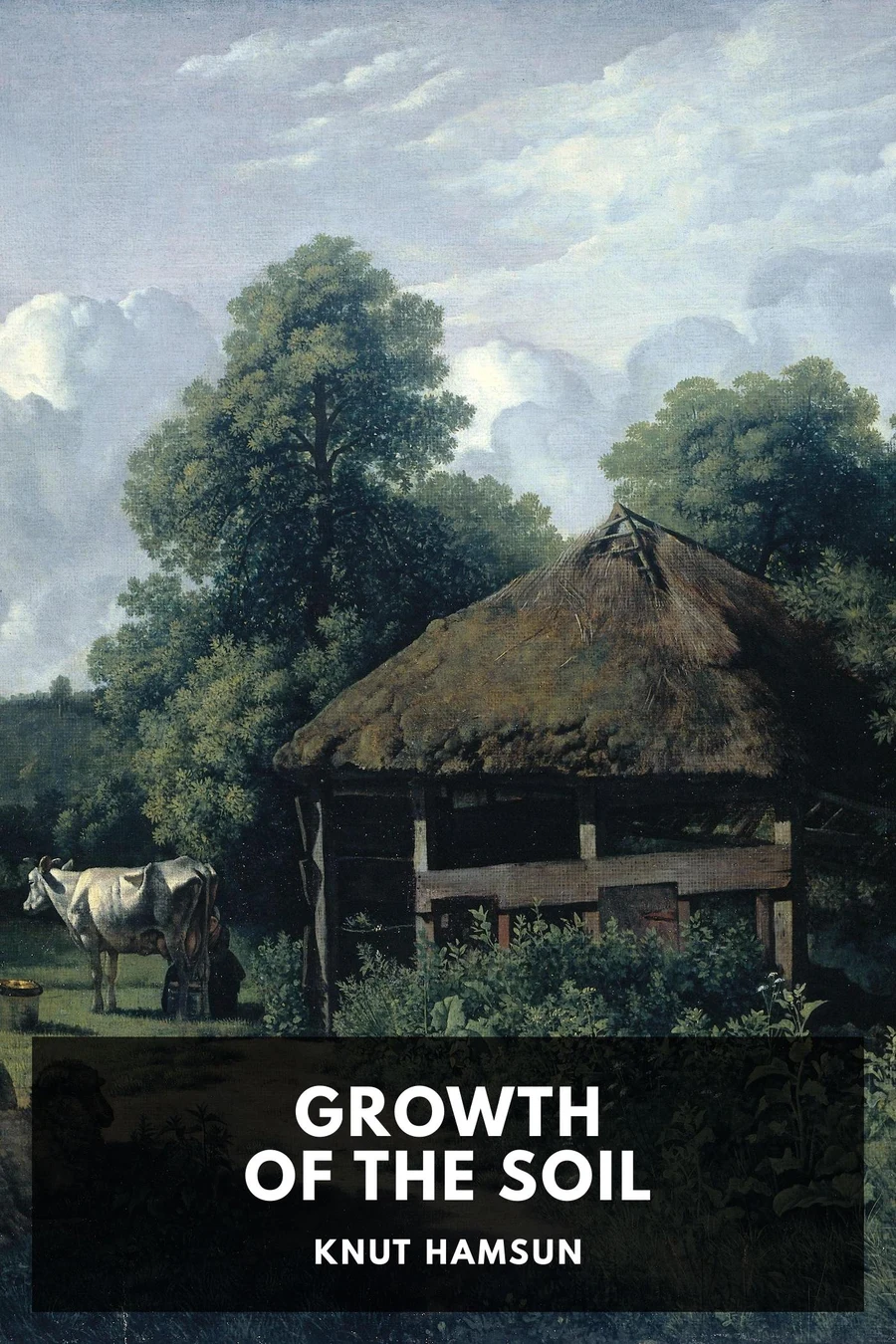
Growth of the Soil
11h 33m
138,581 words
en
Growth of the Soil was published in 1917 to universal acclaim. A mid- to late-career work for Hamsun, it was celebrated for its then-revolutionary use of literary techniques like stream of consciousness, and for its unadorned depiction of pastoral life. Its focus on the quotidian lives of everyday people has led scholars to classify it as a novel of Norwegian New Realism. Isak, a man so strong and so simple that he echoes a primitive, foundational “everyman,” finds an empty plot of land in turn-of-the-century Norway, and builds a small home. He soon attracts a wife, Inger, whose harelip has led her to be ostracized from town life but who is nonetheless a hard and conscientious worker. Together the two earthy beings build a farm and a family, and watch as society and civilization grows and develops around them. Isak and Inger’s toils sometimes bring them up against the burgeoning modernity around them, but curiously, the novel is not one driven by a traditional conflict-oriented plot. Instead, the steady progression of life on the farm, with its ups and downs, its trials and joys, makes the people and their growth the novel’s main propellant. While the humble, homespun protagonists occasionally come into conflict with the awe-inspiring forces of civilization, more often than not, those forces are portrayed as positive and symbiotic companions to the agrarian lifestyle. Hamsun was awarded the Nobel Prize in Literature in 1920 for Growth of the Soil, one of the rare instances in which the Nobel committee awarded a prize for a specific novel, and not a body of work. It has since come to be regarded as a classic of modernist, and Norwegian, literature.
PublisherStandard Ebooks
LanguageEnglish
CopyrightThe source text and artwork in this ebook are believed to be in the United States public domain; that is, they are believed to be free of copyright restrictions in the United States. They may still be copyrighted in other countries, so users located outside of the United States must check their local laws before using this ebook. The creators of, and contributors to, this ebook dedicate their contributions to the worldwide public domain via the terms in the [CC0 1.0 Universal Public Domain Dedication](https://creativecommons.org/publicdomain/zero/1.0/).