The Student
8 min
1,498 words
en
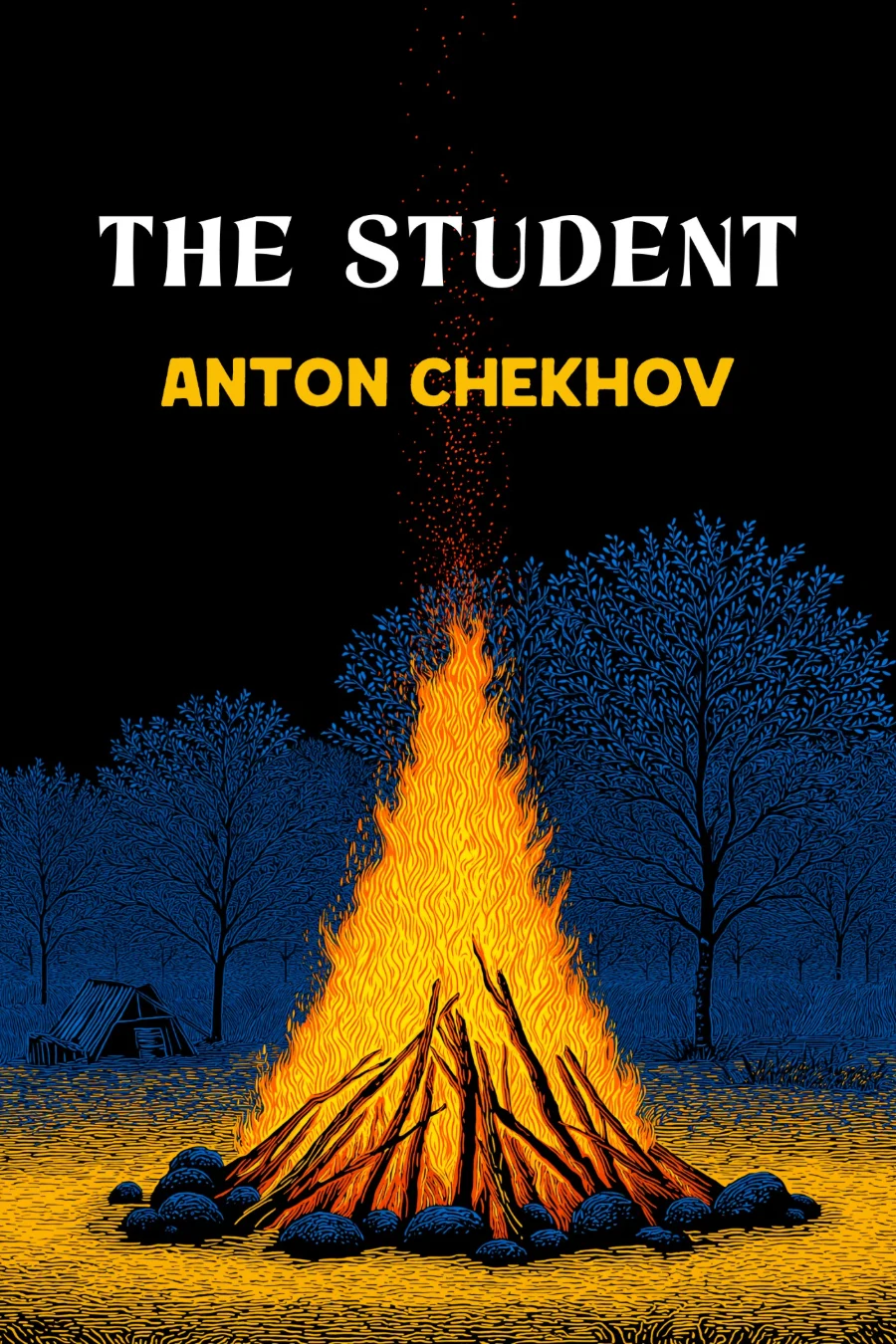
On a cold Good Friday evening, a young theology student walks home through the countryside, his thoughts darkening with the chill. The bitter wind, the desolate landscape, and the poverty he witnesses along his path trigger a creeping despair about the unchanging nature of human suffering—the same ignorance, the same hardship stretching back through centuries of Russian history. In this bleak mood, he stops at a widow's fire to warm himself, and there, almost by accident, he begins to tell a story from the Gospels about another fire on another cold night, when the Apostle Peter waited to learn his master's fate.
What unfolds is Chekhov at his most compressed and luminous, a story that spans barely a few pages yet captures the movement from profound disillusionment to sudden, unexpected illumination. The young man's recitation of the biblical scene—Peter's denial, his subsequent weeping—produces a visible emotional response in his listeners, particularly in one of the women, whose tears seem to spring from a recognition that transcends the centuries between then and now. The story pivots on this moment of connection, this flash of understanding that suggests something fundamental about how human experience travels through time.
Chekhov layers meaning without ever becoming heavy-handed, allowing the theological and philosophical questions to emerge naturally from the concrete details: the smoke from the fire, the expression on a widow's face, the quality of the spring darkness. The story asks whether life is an endless cycle of meaningless suffering or whether there exists some thread of continuity that binds human hearts together across the vast distances of history.
This brief work rewards readers who appreciate literature that operates through suggestion rather than declaration, who find profundity in small moments of recognition. It offers a counterpoint to Chekhov's more pessimistic works, presenting a rare instance where a character moves from darkness toward something approaching grace, though Chekhov never tells us whether this moment of clarity will last beyond the walk home.
Russian LiteratureShort StoriesReligious DoubtSpiritual CrisisRussian RealismEasterIntergenerational ConnectionHistorical ContinuityMelancholyPhilosophical FictionChristianityRural RussiaRedemptionHuman Suffering
PublisherKafka
LanguageEnglish
Source
short-fiction-anton-chekhov