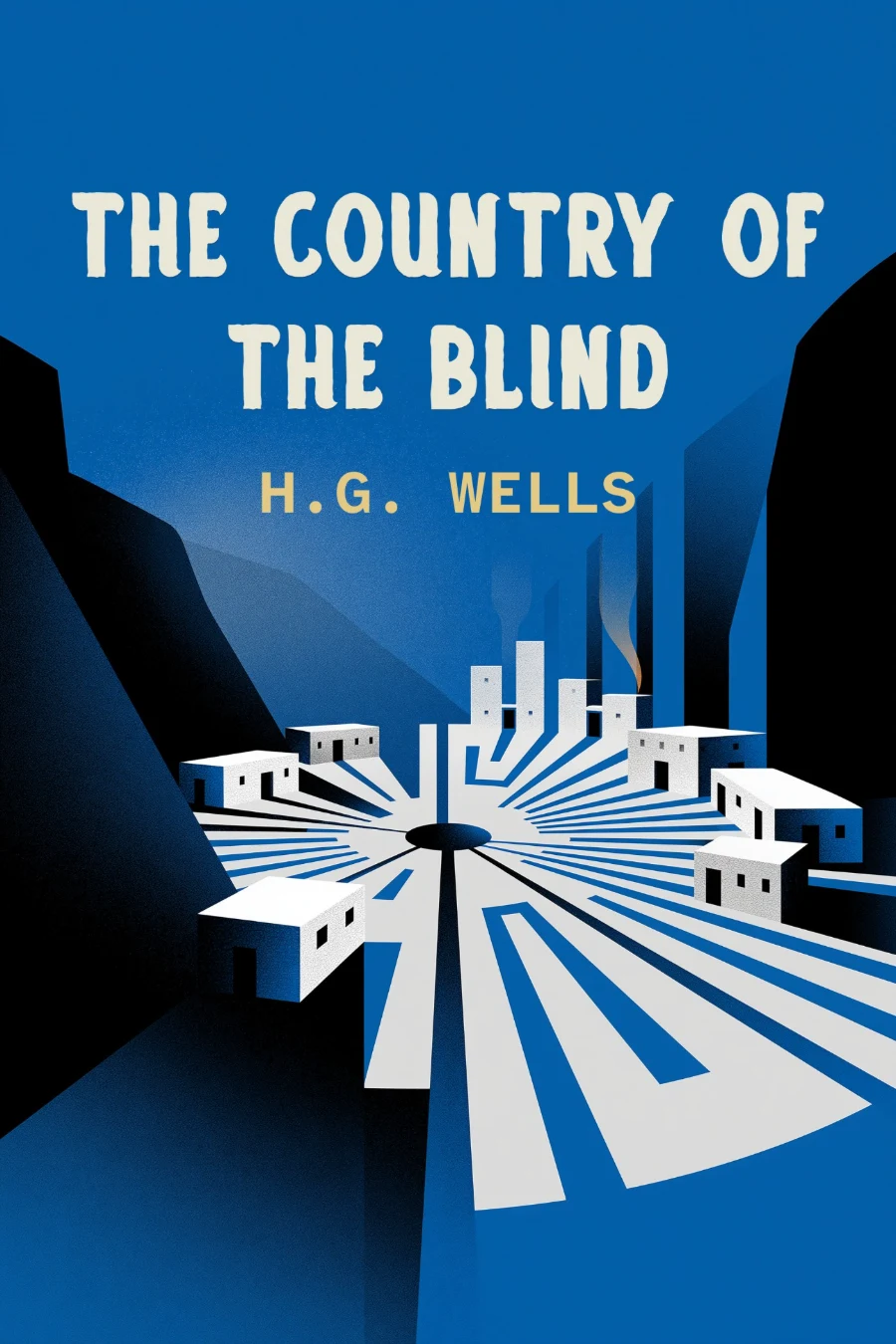
The Country of the Blind
Far beyond the snow-line of the Ecuadorian Andes, sealed off from the world by a catastrophic avalanche centuries before, lies a valley whose entire population has been blind from birth for so many generations that sight has been forgotten as a category of existence. The mountaineer Núñez, separated from his climbing party in a fall, discovers the valley by accident and assumes the old proverb will prove true — in the country of the blind, the one-eyed man is king. Instead he finds a society organized around senses he does not share: the geometry of touch, the architecture of sound, the calendar of warmth. The valley has had fourteen generations to make blindness a virtue and sight a delusion. Núñez has had an afternoon.
Wells published the story in 1904, then revised it in 1939 as he saw the world march into another war. It is one of the purest expressions of his lifelong subject: what happens when human assumptions about superiority collide with environments that have rewritten the rules. The valley-dwellers are not pitiful; they are competent, cultured, mathematically rigorous. Their priests have a fully developed cosmology in which the sky is a smooth roof of rock. Their doctors diagnose Núñez's references to a luminous distance as a kind of brain disease, and propose a humane surgical cure. The reversal is so complete, and rendered so calmly, that we lose track of which side is the deluded one.
The Country of the Blind is one of the great parables of the twentieth century, anticipating arguments about cultural relativism, disability rights, scientific arrogance, and what we mean when we say a faculty is normal. It rewards readers who appreciate idea-driven fiction in the tradition of Borges and Le Guin, who find power in a story that refuses to settle which side is right, and who can feel the chill of a sentence describing a beautiful evening sky to listeners for whom the words have no referent.