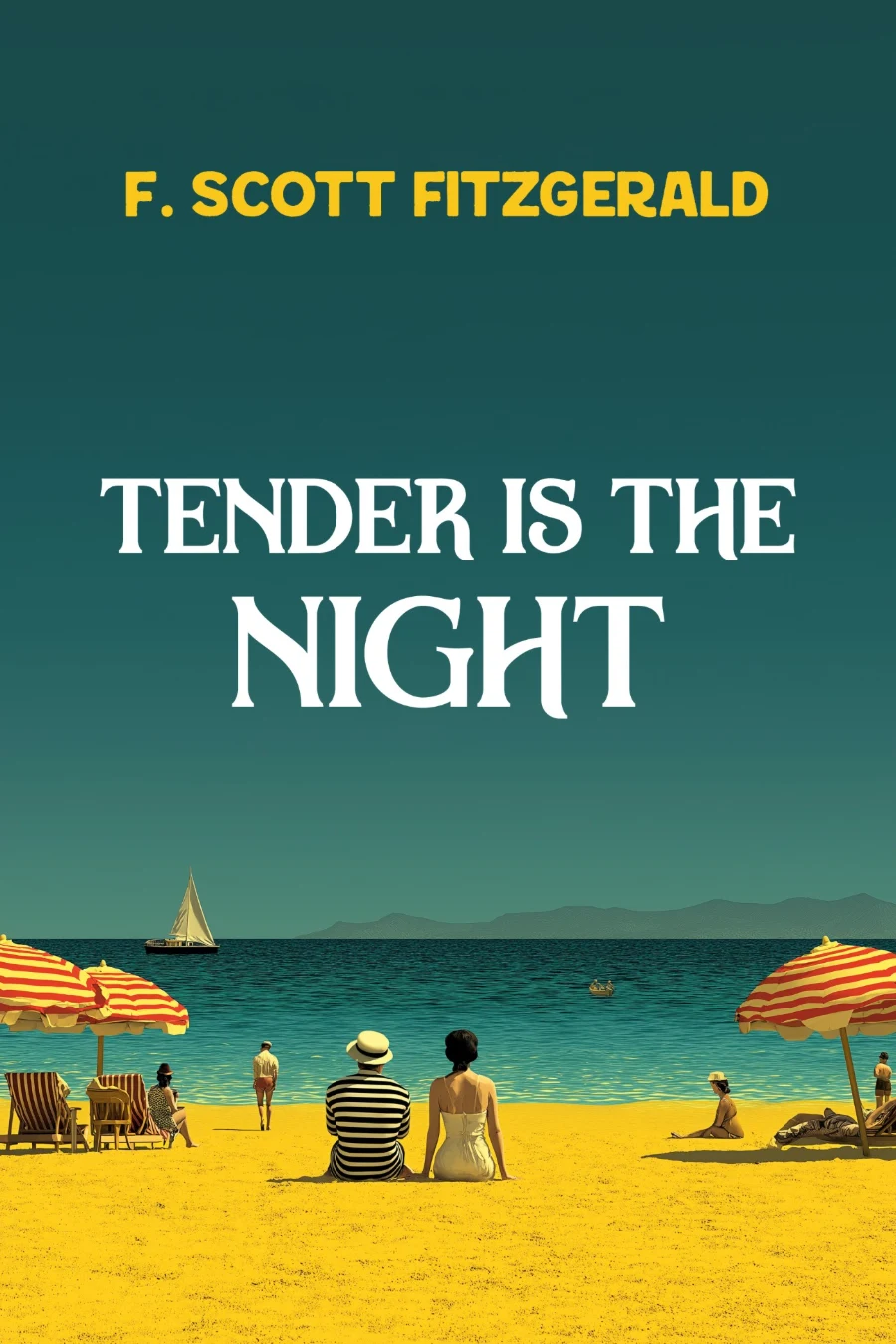
Tender is the Night
On the French Riviera in the 1920s, we meet Dick Diver, a charming American psychiatrist, and his beautiful wife Nicole, who preside over a glittering circle of expatriates with seemingly effortless grace. Their world is one of golden beaches, casual luxury, and endless summer parties where wit flows as freely as champagne. But beneath the sun-drenched surface, we sense something precarious in their perfection—a fragility in Nicole's composure, a studied quality to Dick's magnetism. When young actress Rosemary Hoyt enters their orbit, dazzled by their sophistication, she glimpses only the enchantment, not yet understanding that what appears as ease may require exhausting effort to maintain.


Fitzgerald maps the treacherous territory between caretaking and love, between professional distance and emotional entanglement, between the person we build ourselves into and the person we might have been. The novel moves backward and forward in time, gradually revealing how present arrangements came to be, how certain compromises—even those made with the best intentions—can slowly consume the compromiser. The prose itself mirrors this duality: passages of luminous beauty give way to moments of almost clinical observation, as if Fitzgerald is both enchanted by and diagnostically clear-eyed about his characters' delusions.
The Mediterranean setting, so often associated with healing and pleasure, becomes something more ambiguous here—a place where Americans bring their damages and their fantasies, where money can buy the appearance of health but not its substance. Fitzgerald captures the particular exhaustion of those who give too much of themselves, and the way relationships can hollow out even as their external forms remain intact.
This is a novel for readers drawn to psychological complexity and moral ambiguity, for those interested in the hidden costs of charm and the question of whether love can survive when it originates in need. It rewards patience, as its structure resists straightforward chronology, and it offers no easy consolations. Those willing to inhabit its difficult questions about responsibility, identity, and the limits of devotion will find a work of unflinching emotional intelligence.